

Blog
VSF Oyster Perpetual 36 Jubilee Dial Review: Ref. 126000 Photo Analysis

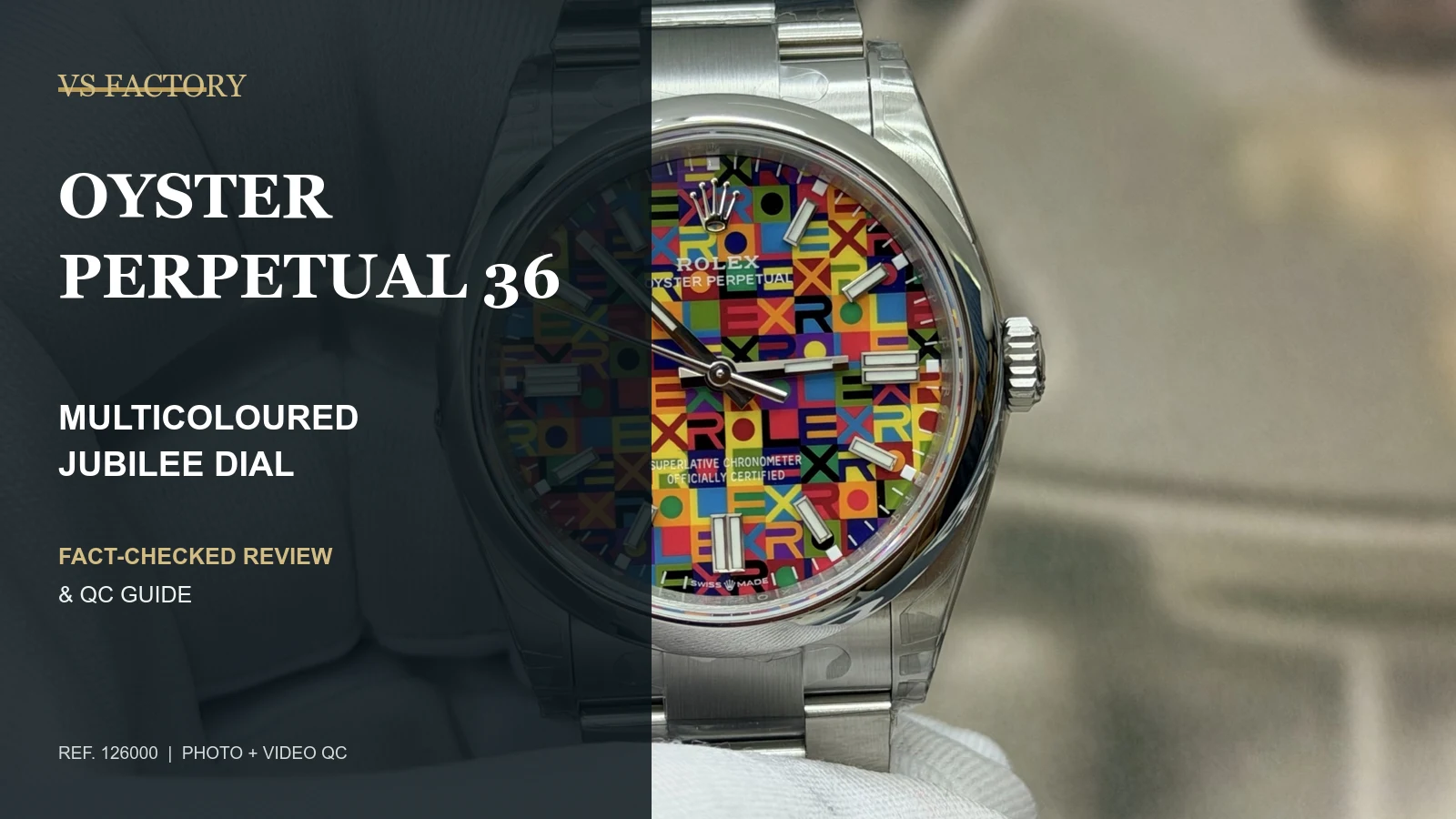
This VSF Oyster Perpetual 36 Jubilee dial review is built for one practical purpose: helping a buyer read the actual photos, video and product record before approving a watch. The subject is the linked VS Factory listing with catalog reference 126000, SKU VSF-19117, an Oyster-style bracelet and a supplier-listed DD3230 movement.
The repeated coloured letters make the dial unusually revealing. Alignment, printing boundaries, marker seating and hand position can all be checked against a dense grid. At the same time, that visual complexity makes exaggerated technical claims easy to hide. This guide therefore distinguishes what Rolex documents for the genuine design, what the supplier lists for the VSF product, and what can be seen directly in the media.
1. Identity, Method and Evidence Levels
The reviewed listing is product #9489, SKU VSF-19117. Five body photographs from the source record match this product’s catalog files byte for byte. The match covers the dial, crown-side case, caseback, closed clasp and open clasp, so the identification does not depend on a similar-looking thumbnail.
An earlier source post labelled the image set as a 41 mm / 124300 watch; the five matching files and product mapping correct the reviewed catalog identity to 36 mm / 126000. The sixth body image is different: it is a previously used generic movement photograph, not a matched image from this product’s ten-picture gallery. It remains below as a clearly labelled educational reference, never as proof that this sample was opened.
Three evidence levels are used throughout the article. Genuine baseline means information stated by Rolex for the genuine m126000-0016. Supplier-listed means a catalog label on the VSF product, such as DD3230. Visible observation means a feature that can be inspected in the supplied images or matching product video. None of these levels should be silently substituted for another.
| Evidence layer | What it establishes | What it does not establish |
|---|---|---|
| Genuine Rolex baseline | Official design name, reference context, Jubilee-motif terminology and genuine configuration. | The materials, tolerances, performance or test results of a VSF sample. |
| Supplier catalog | Product ID, SKU, catalog size family, movement label and the media assigned to the listing. | Independent measurement, internal provenance, rate, reserve, sealing or durability. |
| Photos and video | Visible dial layout, exterior finish, caseback, bracelet, clasp and handling appearance. | Metal composition, hidden construction or functional performance that was not recorded. |
2. Jubilee Motif Versus Celebration Dial
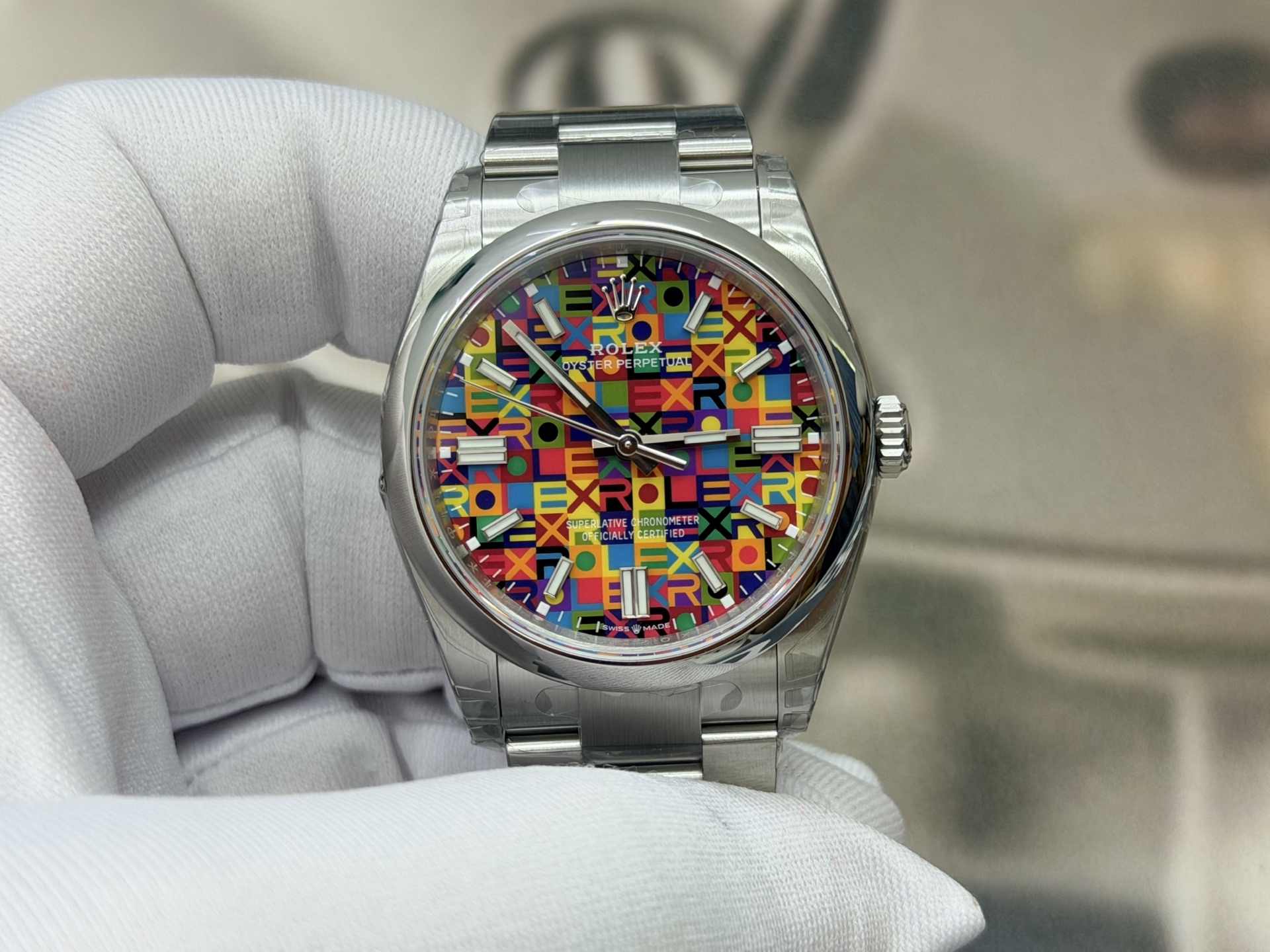
Rolex calls the genuine design a multicoloured, Jubilee-motif dial. Its structure is typographic: the letters R, O, L, E and X repeat across the surface as a geometric field. Rolex’s official model page and Newsroom presentation explain that no fewer than ten colours are applied one after another, with precise positioning required for the shapes and letters.
That description is a reference for understanding the genuine dial, not a manufacturing certificate for the sample. In the supplied straight-on photo, the relevant observable facts are simpler: the letters are visibly repeated, the colour blocks form a dense all-over pattern, and white dial text and applied baton markers sit over that pattern.
A Celebration dial is visually different. It uses overlapping circular bubbles on a turquoise field rather than a repeated letter grid. The two designs are often grouped together in casual search because both are playful and multicoloured, but using the terms interchangeably can send a buyer to the wrong product, the wrong reference images and the wrong QC expectations. Hodinkee’s introduction traces the Jubilee monogram idea to earlier Rolex motif dials, while Monochrome’s hands-on report likewise describes the letters and individually applied colours. Both provide independent context for the genuine watch.
3. Dial, Printing and Handset QC
Start with the whole dial before zooming in. The coloured letter field should read as a continuous composition, with no obvious blank patch, rotated segment or abrupt break that is not explained by a marker. Because the motif supplies many horizontal and vertical cues, a visibly displaced marker or crooked line can stand out more here than on a plain lacquer dial.
Next, use the double markers at the cardinal positions and the minute track as reference lines. Check that the twelve-o’clock crown and marker group sit on the vertical axis, that the lower text is centered, and that the central hand stack appears orderly. A phone image taken off-axis can make one side of the rehaut or minute track look wider, so confirm a suspected alignment issue with a level second photo rather than relying on one perspective.
Then inspect printing boundaries. The source photo is useful for finding obvious colour overlap, missing letter segments, dust or damage, but it is not a calibrated macro test. Compression, sharpening and white-balance processing can create halos along high-contrast edges. Ask for an unfiltered close-up under diffuse light if a coloured boundary looks uncertain.
Finally, judge legibility rather than saturation alone. The same dial can look muted under soft indoor light and much more intense under a directional lamp. A buyer should compare at least one frontal still, one angled still and the video before deciding that a hue is wrong. More importantly, the polished marker frames, hands and white text should remain readable over the busy background.
4. Smooth-Bezel Case Profile and Solid Caseback
The crown-side photograph shows the defining time-only profile: smooth bezel, curved case flank, winding crown and the first bracelet links. Use it to inspect transitions rather than to estimate dimensions. The bezel should appear concentrically seated, the crystal-to-bezel boundary should look even, and the crown should not appear visibly tilted relative to the case tube. Compare the upper and lower lug silhouettes for a broad symmetry check.
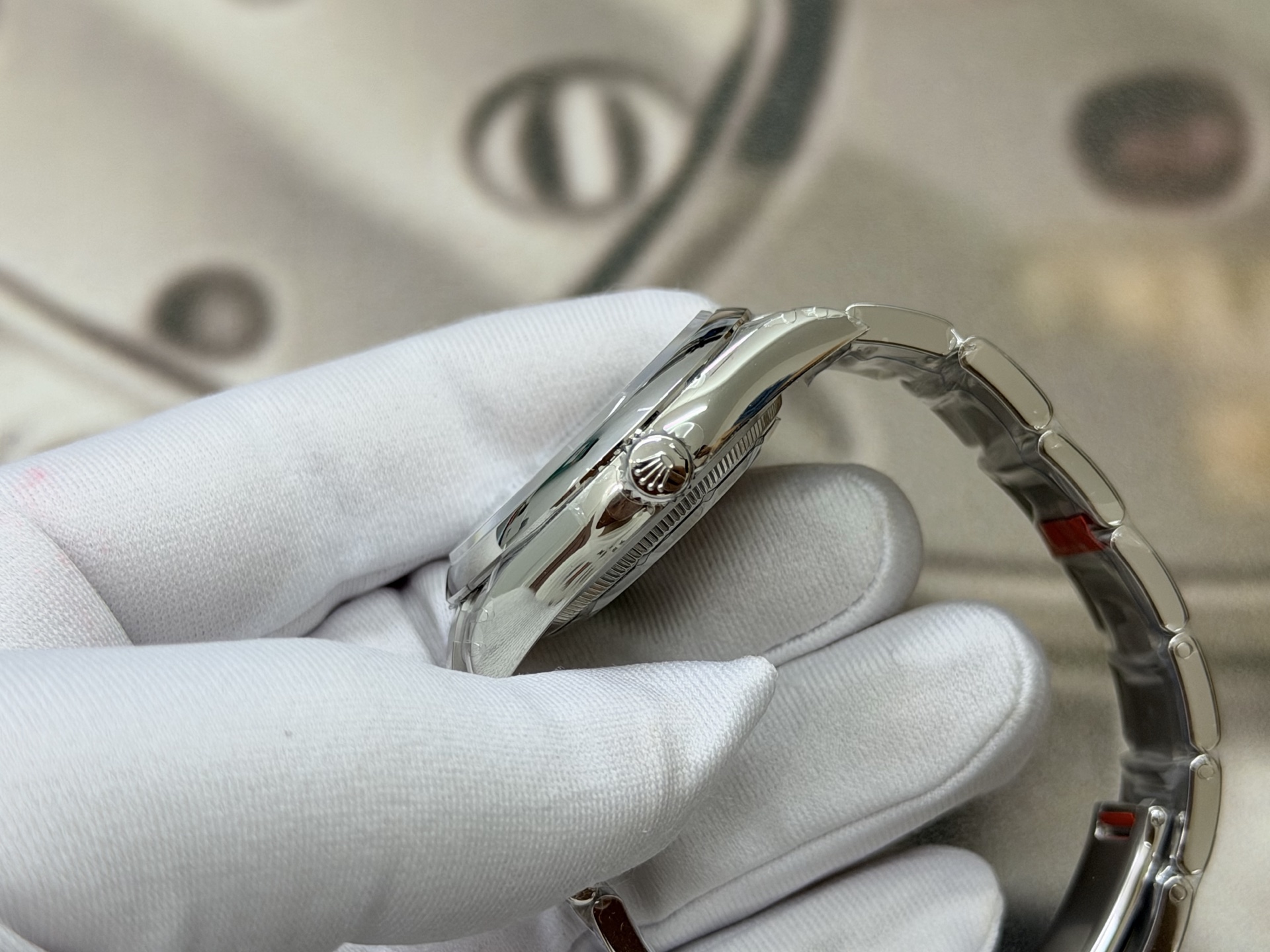
Polished surfaces are highly sensitive to lighting. A clean highlight can demonstrate continuity, but it cannot rule out a line that sits outside the reflected band. For exact-unit QC, ask for one diffuse image and one raking-light image of each case side. Protective film should be identified because its edges, air pockets and trapped dust can resemble finishing defects.
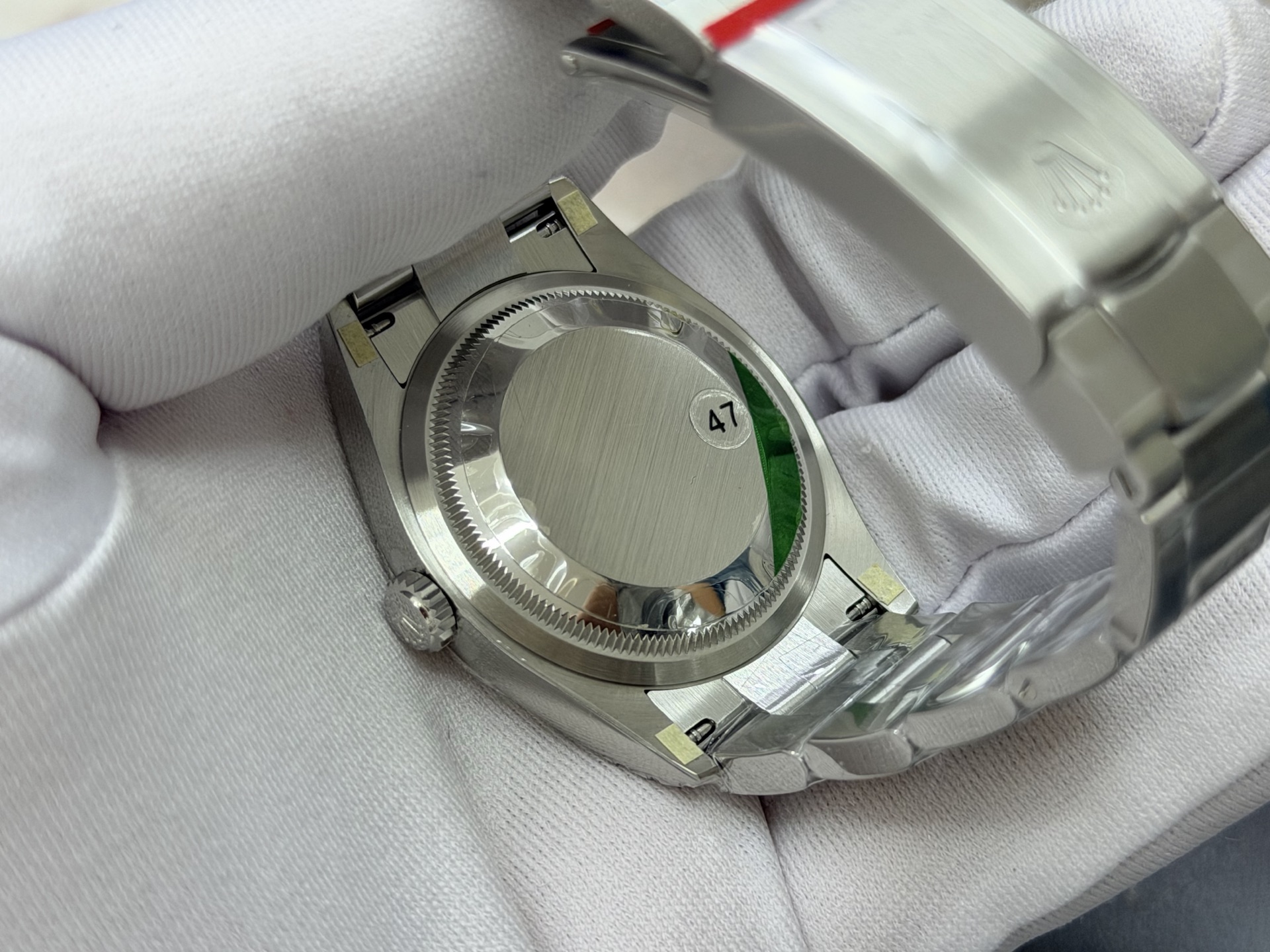
The rear photograph records a closed, solid caseback and the end-link area. Check that the caseback perimeter appears evenly seated, that the brushing looks coherent in the photo and that no obvious deep mark crosses the visible surface. A closed rear view provides no access to the installed movement or gasket. It therefore cannot support a teardown claim or any conclusion about sealing.
5. Oyster-Style Bracelet, Clasp and Visible Markings
The exterior clasp view is useful for judging broad finish consistency, the coronet area, edge condition and the way the bracelet enters the clasp. Look for a visibly skewed closure, an unexpected gap or a sharp mismatch in brushing direction. Film can change the apparent colour and texture, so the best final check is a clean photo after film removal, provided the seller’s approval process permits it.
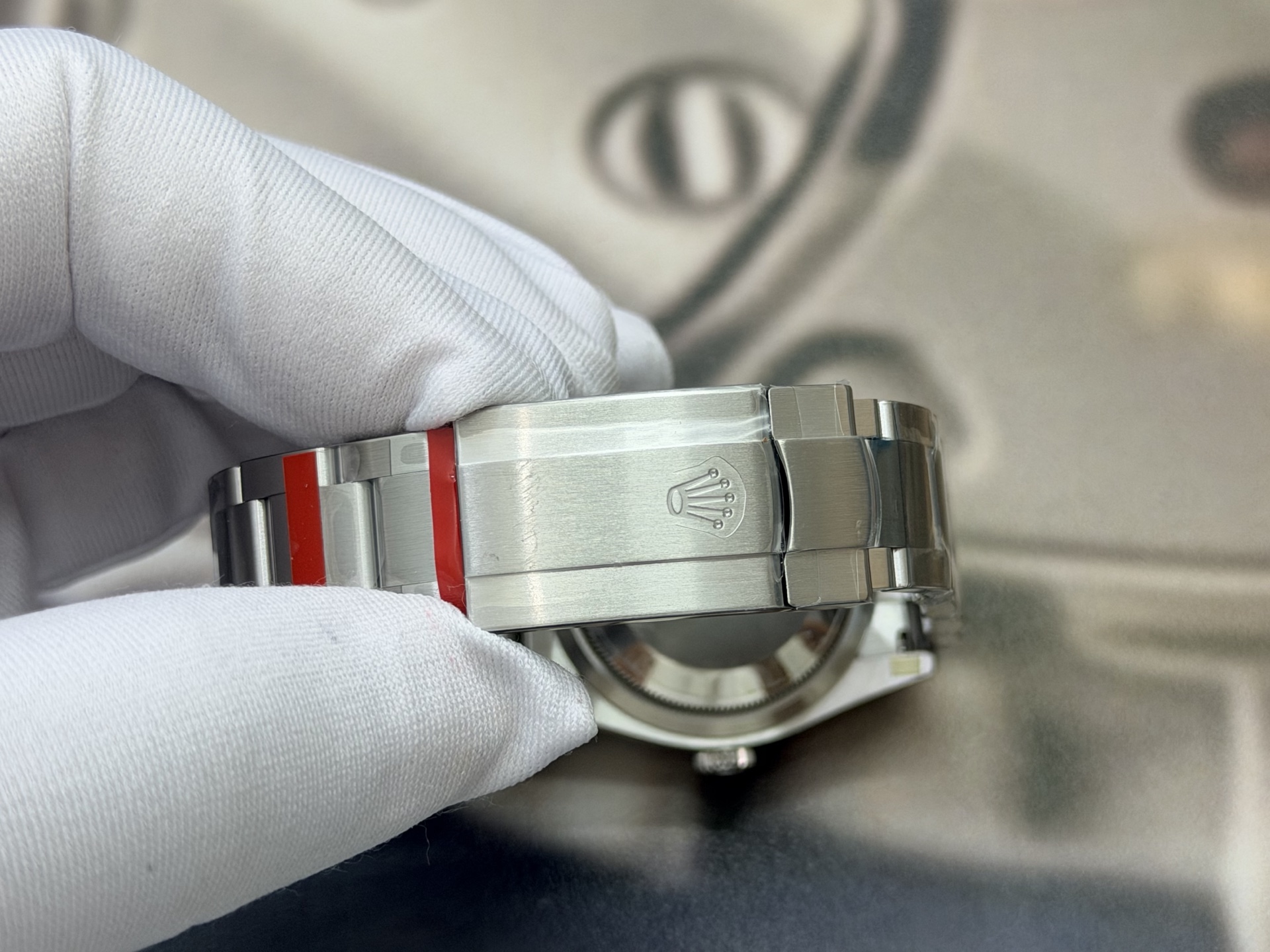
The open-clasp photo adds the folding blades, interior finish and stamped or engraved details. One visible marking reads U7T. That is an observation about this photograph only. A code is not an independent factory certificate, a universal batch key or evidence of a metal grade. Do not approve or reject a watch solely from that marking.
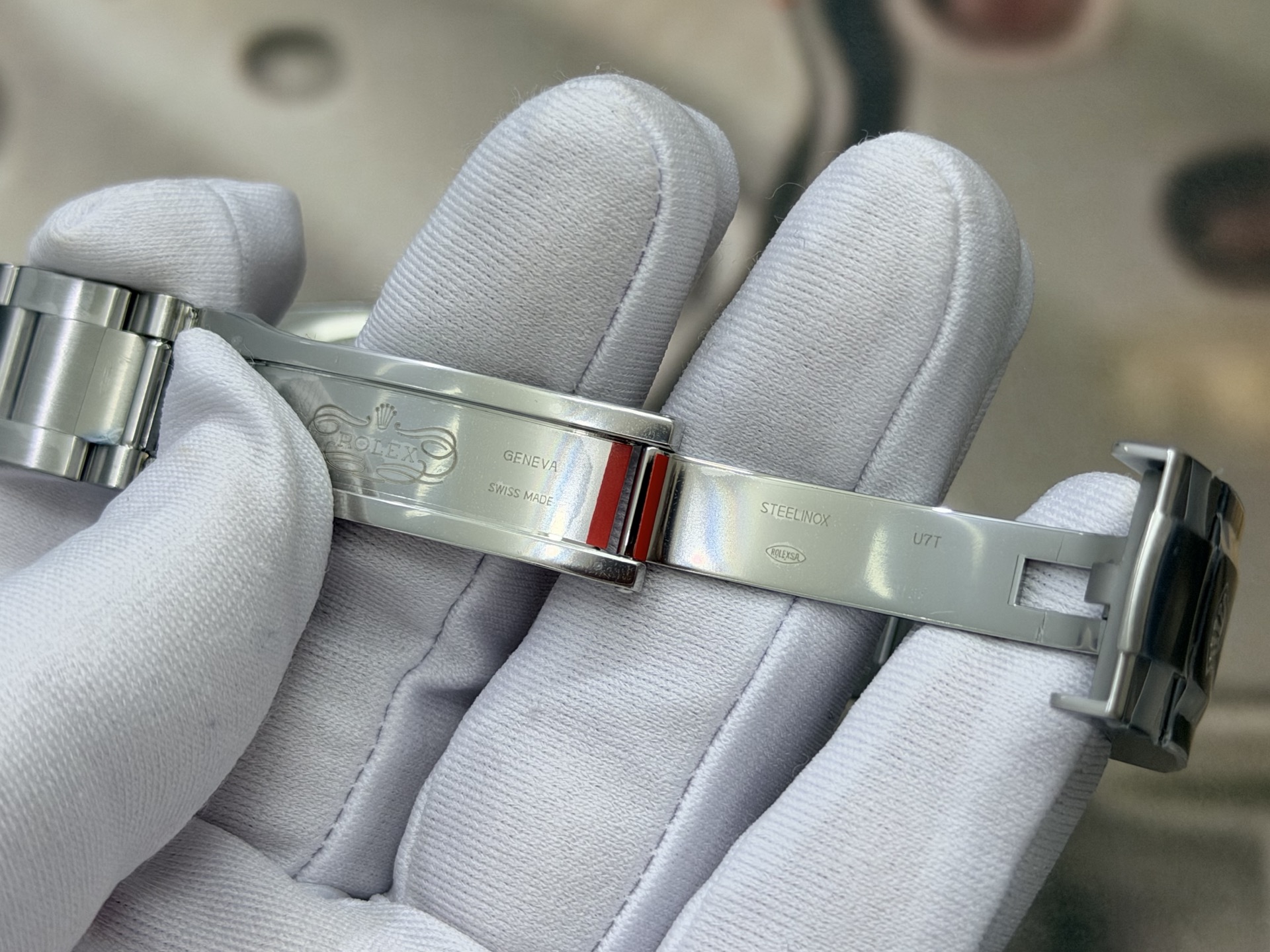
Still photographs do not test clasp force. Ask the seller to show a complete open-close cycle in the exact-unit QC video, including both release points and the final locked position. Also request a short bracelet articulation view so a stiff, twisted or poorly seated link is easier to identify before shipment.
6. Matching Product Video: What Motion Adds
The locally hosted video belongs to the same linked product record. It gives the multicoloured dial a second lighting condition and shows how the bezel, crystal, markers and polished surfaces respond as the watch moves. This is especially helpful because a single still can overstate or suppress saturation.
The clip should not be stretched beyond what it records. It does not open the case, document a full crown-setting sequence or provide a synchronized timing instrument. For an order decision, ask for a new video of the exact unit with a date or order identifier in frame, a slow rotation under neutral light and a separate demonstration of winding and hand setting.
7. Supplier-Listed DD3230 and the Generic Movement Image
The product page uses the designation DD3230. The accurate wording is therefore “supplier-listed DD3230,” not “independently verified DD3230.” A catalog label helps identify the version a seller intends to offer, but it does not prove the installed mechanism in a sealed watch or predict the performance of every delivered unit.
The portrait-format movement photograph below is included because it appeared in the source material, but file comparison does not link it to the ten-image gallery for SKU VSF-19117. It is a generic reference image already used elsewhere. It may illustrate the appearance of a decorated automatic movement and visible bridge layout; it cannot establish what sits behind the closed caseback shown above.
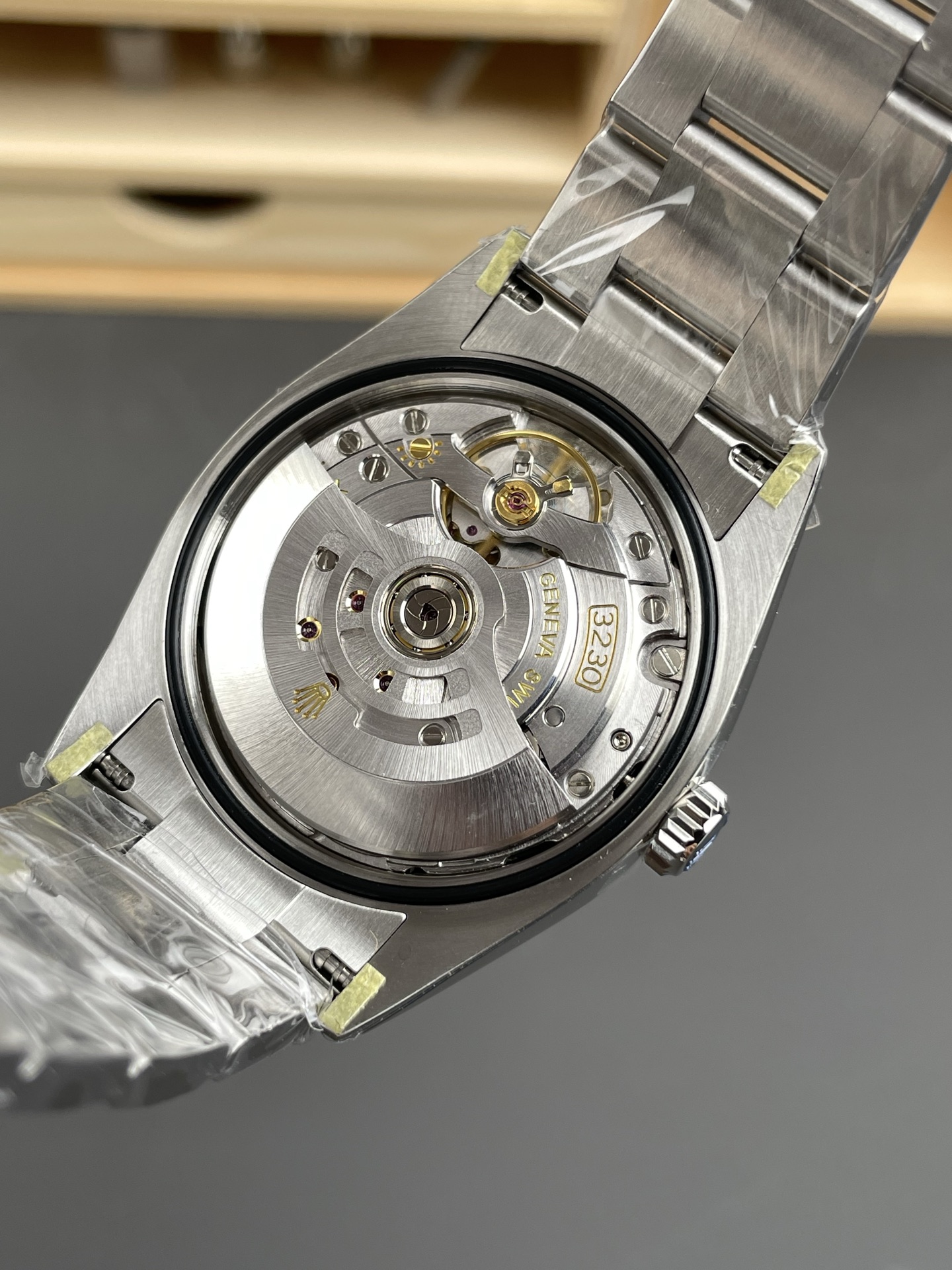
Movement questions require unit-specific evidence. Request a photo taken after the exact caseback is opened, with the watch identifier kept in the same sequence. For functional QC, request a continuous video of winding, time setting and hand movement, plus a dated timegrapher reading if rate behavior matters. A reserve claim would require a fully wound, time-stamped run under stated conditions; no such trial is included here.
The same restraint applies to water exposure. Exterior crown and caseback photos can identify obvious damage or poor seating, but they do not show the result of a pressure test. Treat intended swimming or immersion as a separate service and evidence question, not a conclusion drawn from model naming.
8. Technical and Visual Evidence Table
This table keeps the genuine design reference, catalog statements and observed sample details in separate columns. It is deliberately conservative so a specification from the genuine watch is not presented as a test result for the VSF product.
| Topic | Record | Buyer-facing conclusion |
|---|---|---|
| Genuine design baseline | Rolex Oyster Perpetual 36, reference 126000, configuration m126000-0016. | Use for design identity and official terminology only. |
| VSF listing | Product #9489, SKU VSF-19117. | This is the exact internal product link for the article. |
| Dial | Multicoloured repeating ROLEX-letter Jubilee motif. | Visible in the matched frontal image and matching product video. |
| Nominal size family | 36 mm in the official genuine identity and VSF catalog title. | Catalog identity; the photographed sample was not measured here. |
| Case and bracelet | Smooth-bezel case, solid caseback and Oyster-style bracelet are visible. | Inspect exterior condition and fit; no metal-grade claim is made. |
| Movement | DD3230 is the supplier’s listing label. | Confirm the installed movement and function on the exact unit. |
| Movement photograph | Generic image; not matched to the product gallery. | Do not call it a teardown of this watch. |
| Timing, reserve and sealing | No unit-specific instrument or pressure-test record supplied. | No performance or water-resistance promise is made. |
Photo-by-photo decision matrix
| Medium | Best use | Follow-up when uncertain |
|---|---|---|
| Front dial | Motif identity, marker seating, handset, minute track and visible printing. | Request level macro photos under diffuse and angled light. |
| Crown-side case | Bezel seating, crown alignment, case transitions and lug silhouette. | Request both sides under raking light after identifying film. |
| Caseback | Exterior condition, seating and end-link area. | Request a separate opened-case sequence for movement identity. |
| Closed clasp | Surface condition, coronet area and closure alignment. | Request a complete open-close video. |
| Open clasp | Folding blades, hinge area and visible markings. | Test function; do not authenticate from a code. |
| Product video | Colour response, reflections and exterior appearance in motion. | Request a dated exact-unit functional video. |
| Generic movement image | General visual reference only. | Do not use for this sample’s movement approval. |
9. Exact-Unit QC Checklist Before Approval
- Confirm the listing. Match the order to product #9489 and SKU VSF-19117 rather than relying on a generic colourful-dial description.
- Confirm the motif. The face should use the repeated multicoloured ROLEX-letter grid, not overlapping circular bubbles.
- Request a level front image. Keep the camera centered and move the hands away from key text and markers.
- Check the central axis. Compare the crown logo, twelve marker, hand stack and lower printing against the dial’s vertical line.
- Inspect colour boundaries. Look for a clearly missing segment, obvious overlap, damage or debris; verify suspected issues with an unfiltered macro.
- Compare lighting. Use a diffuse still, angled still and motion clip before judging saturation or finish.
- Review the case from both sides. Check bezel seating, crown alignment, lug symmetry and visible handling marks after accounting for film.
- Inspect the caseback. Look for even seating and exterior damage, but do not infer the installed movement from a closed back.
- Check both end links. Confirm that the bracelet meets the case evenly and that no link appears twisted or poorly seated.
- Test the clasp. Request a continuous open-close sequence showing the hinge, release and final lock.
- Treat markings as observations. Record visible codes for comparison without converting them into factory or batch guarantees.
- Verify crown functions. Ask for one continuous video covering winding, time setting and return to the normal crown position.
- Request measurements only when needed. If fit is critical, ask the seller to measure the exact unit with the tool visible rather than copying a catalog number.
- Separate functional tests. Obtain a dated timegrapher reading and an appropriate pressure-test record when those results matter to your use.
- Archive the approved media. Keep the order identifier, photos, video and test records together so the shipped watch can be compared with the approved unit.
A rejection should point to one reproducible issue: for example, “the six-o’clock marker appears rotated in both level photos” or “the clasp does not lock during the continuous video.” Specific evidence is easier to resolve than a broad request for a “better watch,” and it reduces the chance that a camera angle is mistaken for a defect.
10. Product, Categories and Related Guides
The direct commercial destination is the VSF Oyster Perpetual 36 multicolour Jubilee-motif product page. The live product page is the appropriate source for current price and availability. For alternatives, browse the Oyster Perpetual 36mm collection or the broader Rolex catalog.
Ready to compare the current batch? Open the matching SKU VSF-19117 product page, then request exact-unit media against the checklist above before approval.
Frequently Asked Questions
Is this a Celebration dial?
No. This is a multicoloured Jubilee motif built from repeated ROLEX letters. A Celebration dial uses overlapping circular bubbles on a turquoise field, so the two names should not be used interchangeably.
What is the correct identity of the reviewed listing?
The reviewed site listing is product #9489, SKU VSF-19117, catalogued as an Oyster Perpetual 36 with reference 126000 and a multicoloured Jubilee-motif dial.
Does the video show the matching product?
Yes. The locally hosted clip is attached to the same product record and shows the matching dial design in motion. It is product-level visual evidence, not a complete functional test of the exact unit sent with every order.
Is the movement photograph a teardown of this watch?
No. The movement photograph is a generic reference image that does not match the reviewed product’s gallery. The matched rear photograph shows a closed caseback, so an opened exact-unit sequence is needed to identify the installed movement visually.
What does the DD3230 description prove?
DD3230 is the supplier-listed movement designation. It does not by itself guarantee movement provenance, timing accuracy or power reserve; those questions require evidence from the individual watch.
Does the visible U7T marking authenticate a factory or batch?
No. U7T is a marking visible in the supplied clasp photograph. Record it as a photographed detail, not as an independent factory certificate, universal batch code or material guarantee.
Is water resistance guaranteed by the case and crown photos?
No. Exterior photos can reveal obvious condition or seating issues, but they cannot establish water resistance. Request an appropriate pressure-test record for the exact watch if exposure to water matters.
Sources for the Genuine Design Baseline
- Rolex: Oyster Perpetual 36, m126000-0016
- Rolex Newsroom: New Oyster Perpetual 36
- Hodinkee: Introducing the Oyster Perpetual 36 Jubilee Dial
- Monochrome: Hands-On with the Multicoloured Jubilee Dial
Final assessment: this listing is best evaluated as a photo-led, exact-unit purchase. Its model mapping and five matched exterior images are strong; the supplier’s movement label and the separate generic movement image are not substitutes for opening and testing the watch. Keep those boundaries intact and the colourful dial becomes easier, not harder, to assess.