

Blog
VS Factory Omega Planet Ocean 600M Chronograph: VSF vs Low-Grade Batches


The VS Factory Omega Planet Ocean 600M Chronograph is difficult to judge from a logo or movement label alone. The useful differences appear in the applied dial furniture, recessed chronograph registers, ceramic surface, anti-reflective behavior, case engravings, bracelet fit and the construction hidden inside the clasp.
This updated VSF Omega Planet Ocean 600M review examines eight unique macro comparison images from the current VS Factory sample and a low-grade market batch. It also adds the official Omega Ref. 215.30.46.51.01.001 baseline, a buyer-focused QC checklist and clear limits on what static photography can prove.
1. Reference, Method and Genuine Specifications
The black-dial, steel-bracelet design used as the reference target is the genuine Omega Seamaster Planet Ocean 600M Co-Axial Master Chronometer Chronograph 45.5 mm, Ref. 215.30.46.51.01.001. Omega lists a black ceramic dial, black ceramic unidirectional bezel, date at 6 o’clock, small seconds at 9 and combined 60-minute and 12-hour chronograph counters at 3.
| Reference | 215.30.46.51.01.001 |
|---|---|
| Case | 45.5 mm stainless steel; 52.30 mm lug-to-lug; 18.87 mm thick |
| Lug width and weight | 22 mm; approximately 262 g on the steel bracelet |
| Dial and bezel | Black ceramic dial and black ceramic dive bezel with Liquidmetal scale |
| Crystal | Domed sapphire with anti-reflective treatment on both sides |
| Genuine movement | Omega Calibre 9900, self-winding chronograph, 60-hour power reserve |
| Genuine certification | Master Chronometer tested by METAS; resistance to magnetic fields up to 15,000 gauss |
| Genuine water rating | 60 bar / 600 metres / 2,000 feet, with helium-escape valve |
| Clasp | Foldover clasp with comfort setting and diver extension |
The official reference page establishes the target architecture. The side-by-side macro images establish only what is visible in the compared samples. We reviewed the source article revision published on August 8, 2026, removed unsupported absolute claims and checked each observation against the corresponding image.
Inspection method: compare relief, edge finishing, surface reflectivity, alignment, engraving depth and mechanical architecture one component at a time. Do not infer pressure resistance, timing stability, material composition or movement certification from a single photograph.
2. Dial Logo, 12 Marker and Sub-Dial Geometry
The dial is the fastest place to separate a premium build from a budget Planet Ocean copy because several manufacturing processes meet in one small area. Applied metal, lacquer, printing and recessed register machining must all remain clean under magnification.
Applied Omega logo and orange 12 marker
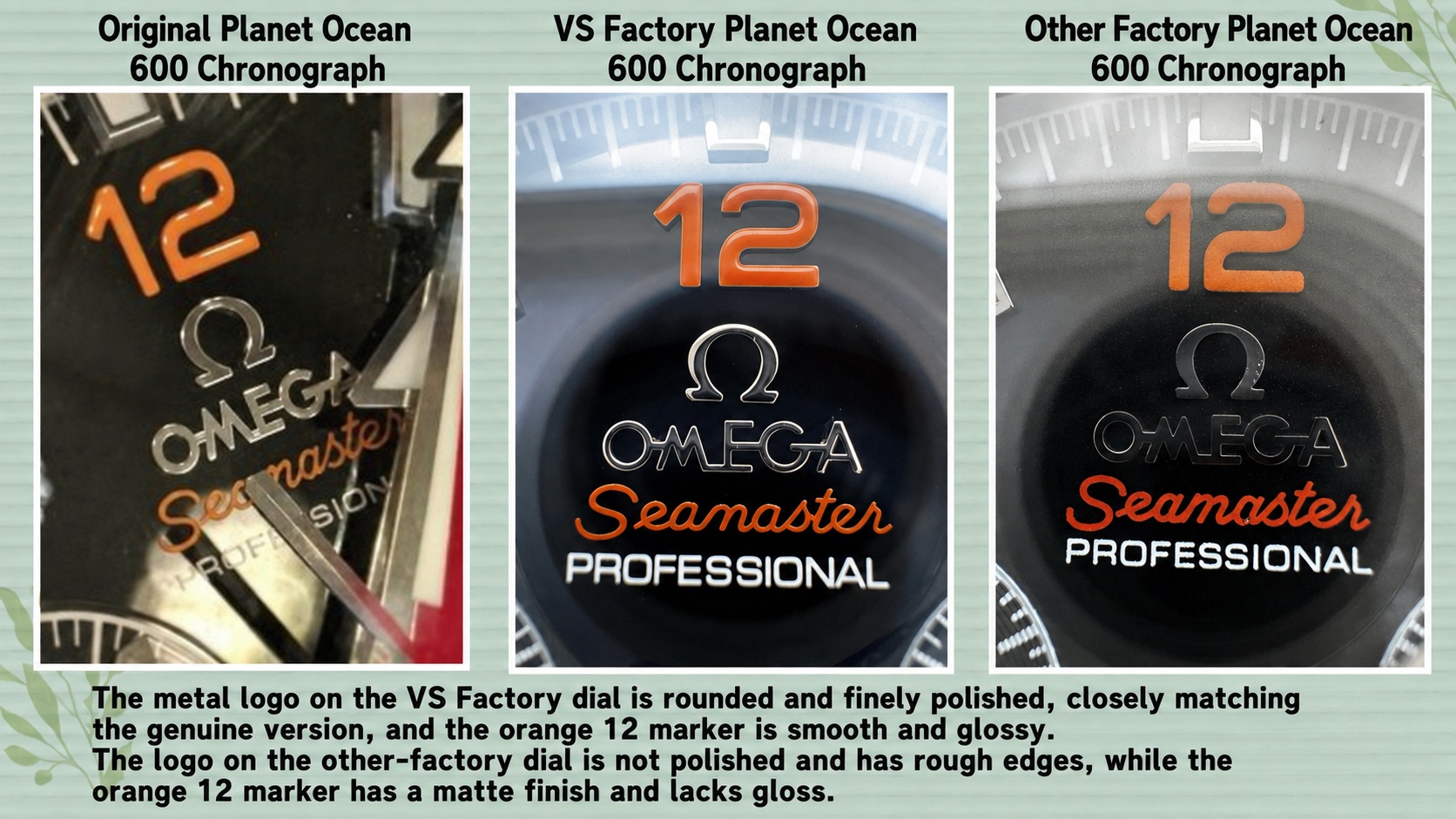
- VSF sample: the applied Omega emblem has rounded, reflective bevels and a cleaner perimeter. The orange insert at 12 shows a smoother, glossier surface.
- Low-grade sample: the emblem appears flatter, with rougher stamped edges. The orange marker looks granular and matte under the same close framing.
- What to check on your unit: request a level dial photo without protective film crossing the logo. Compare the emblem’s centering, the gap to the wordmark and whether lacquer fills the 12 marker evenly.
Recessed chronograph sub-dials and azurage
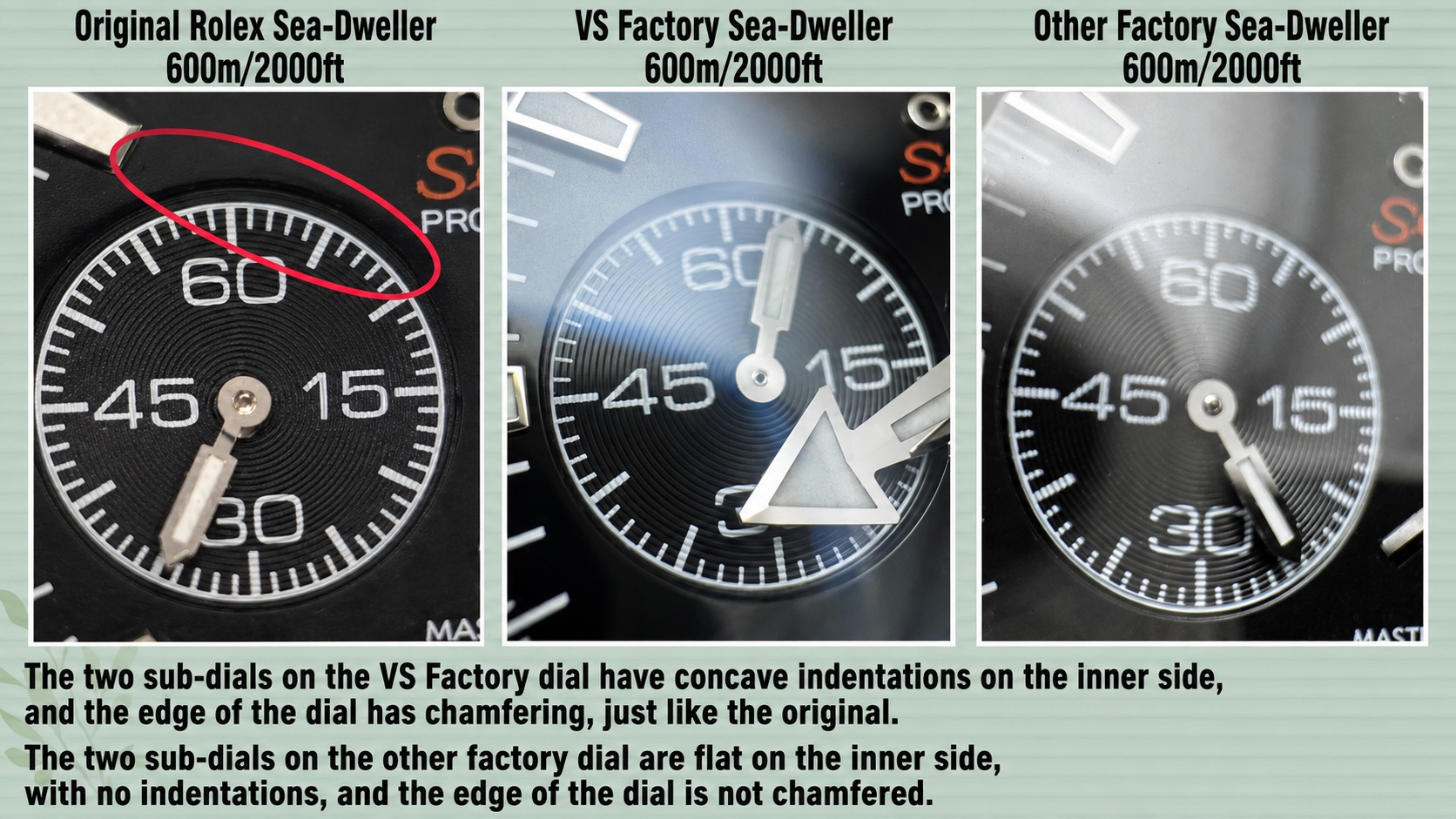
On the photographed VSF model, the register drops below the main dial plane and the perimeter catches light as a separate chamfer. Fine concentric azurage gives the surface additional depth. The low-grade register relies more heavily on printing and lacks the same stepped transition.
This is more important than a broad claim such as “same as genuine.” A buyer can ask for one shallow-angle image and verify whether the recess and edge remain visible as the light moves. A flat register will not gain depth from a better camera angle.
3. Ceramic Dial, Date Window and AR Behavior
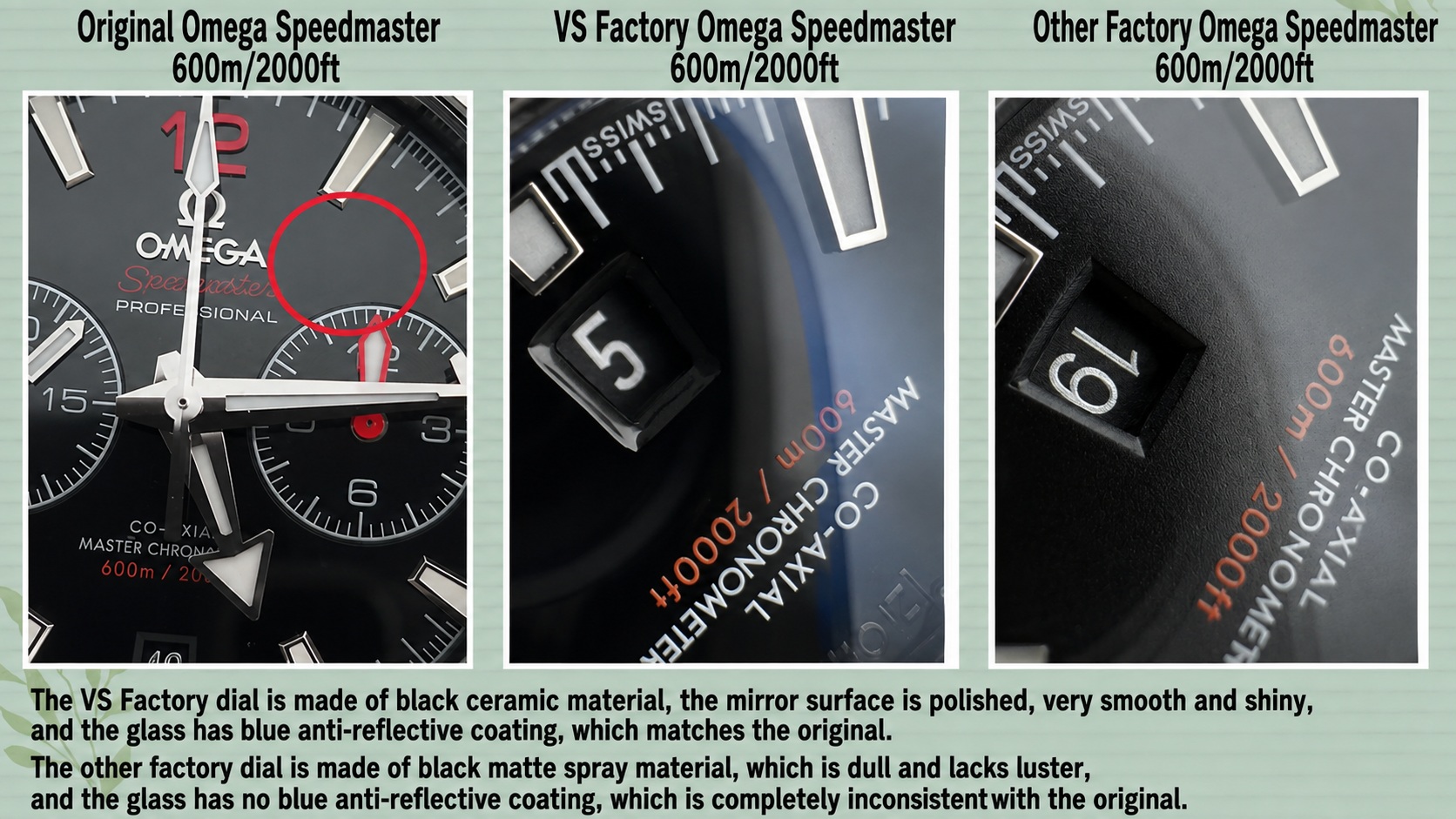
The VSF side shows a deeper black, more mirror-like dial surface and lower veiling glare over the printed details. The low-grade side appears greyer and more diffuse. That visual difference is consistent with a better polished ceramic-style surface and stronger anti-reflective treatment, but a photograph cannot prove the dial’s chemical composition or whether coating exists on both crystal surfaces.
- Dial surface: inspect the black area between markers for orange peel, dust, uneven gloss or a sprayed-metal texture.
- Date aperture: check the bevel, vertical centering and side spacing at more than one date. One centered numeral does not prove the entire wheel.
- Crystal and AR: request a straight-on shot and a shallow-angle shot under the same light. Look for clarity and color consistency, not a dramatic blue reflection produced by editing.
Omega specifies double-sided anti-reflective treatment for the genuine reference. Treat that as a genuine benchmark only. The exact replica unit still needs inspection for scratches, coating marks and distortion.
4. Case Engravings, Caseback and Movement View
Underside lug markings and serial execution
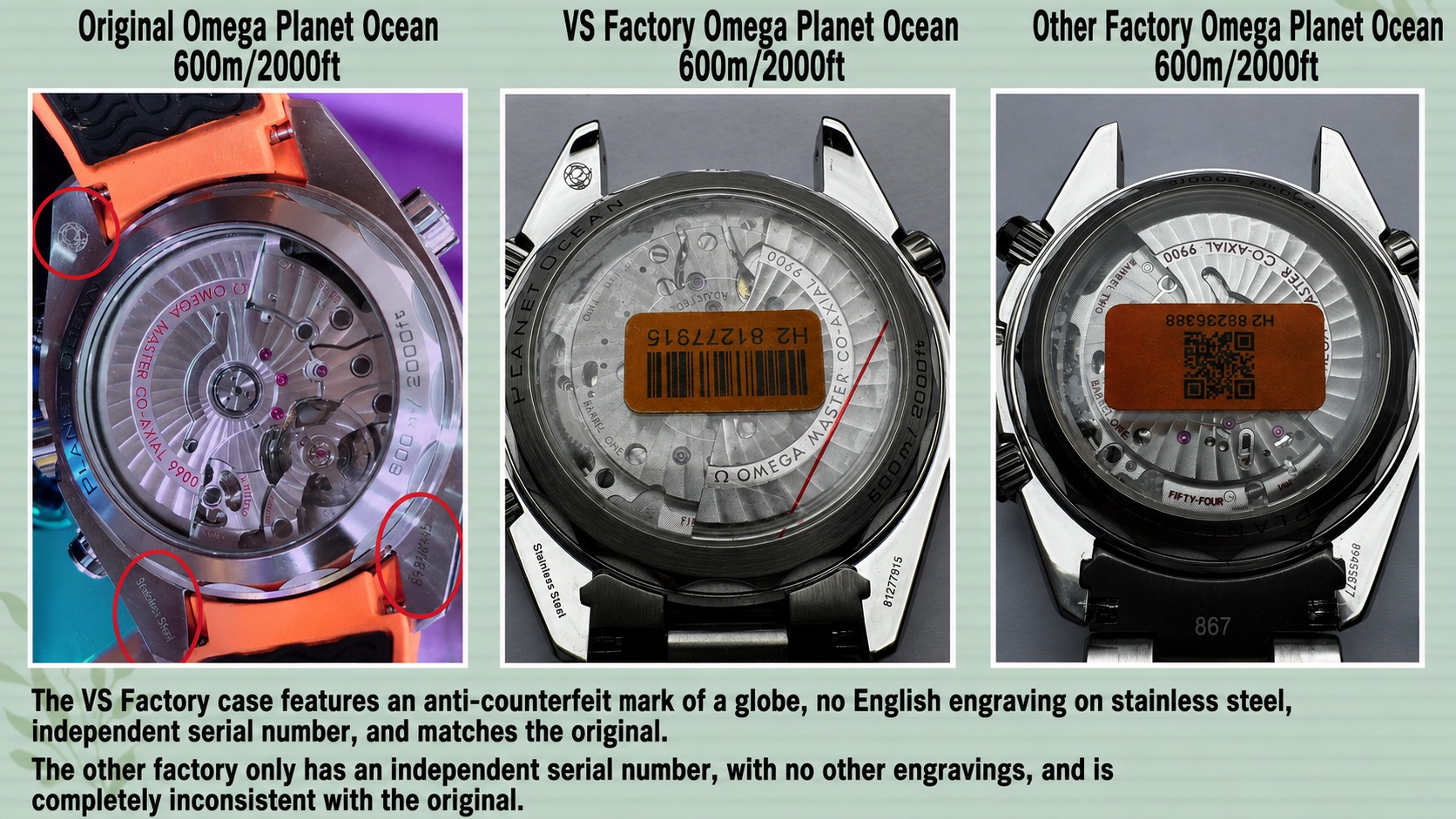
The photographed VSF case includes three distinct marking groups under the lugs: an emblem, material lettering and a serial code. The characters appear deeper and more deliberate than the shallow serial-only treatment on the low-grade case. Check spacing and edge definition rather than assuming that the mere presence of a code confirms factory identity.
Serial formats can be repeated across batches. A serial is therefore a supporting clue, not stand-alone proof that a watch came from VS Factory. Current-batch packaging, movement photographs and seller-supplied unit evidence should agree with the case markings.
Caseback ring, lettering and visible movement architecture
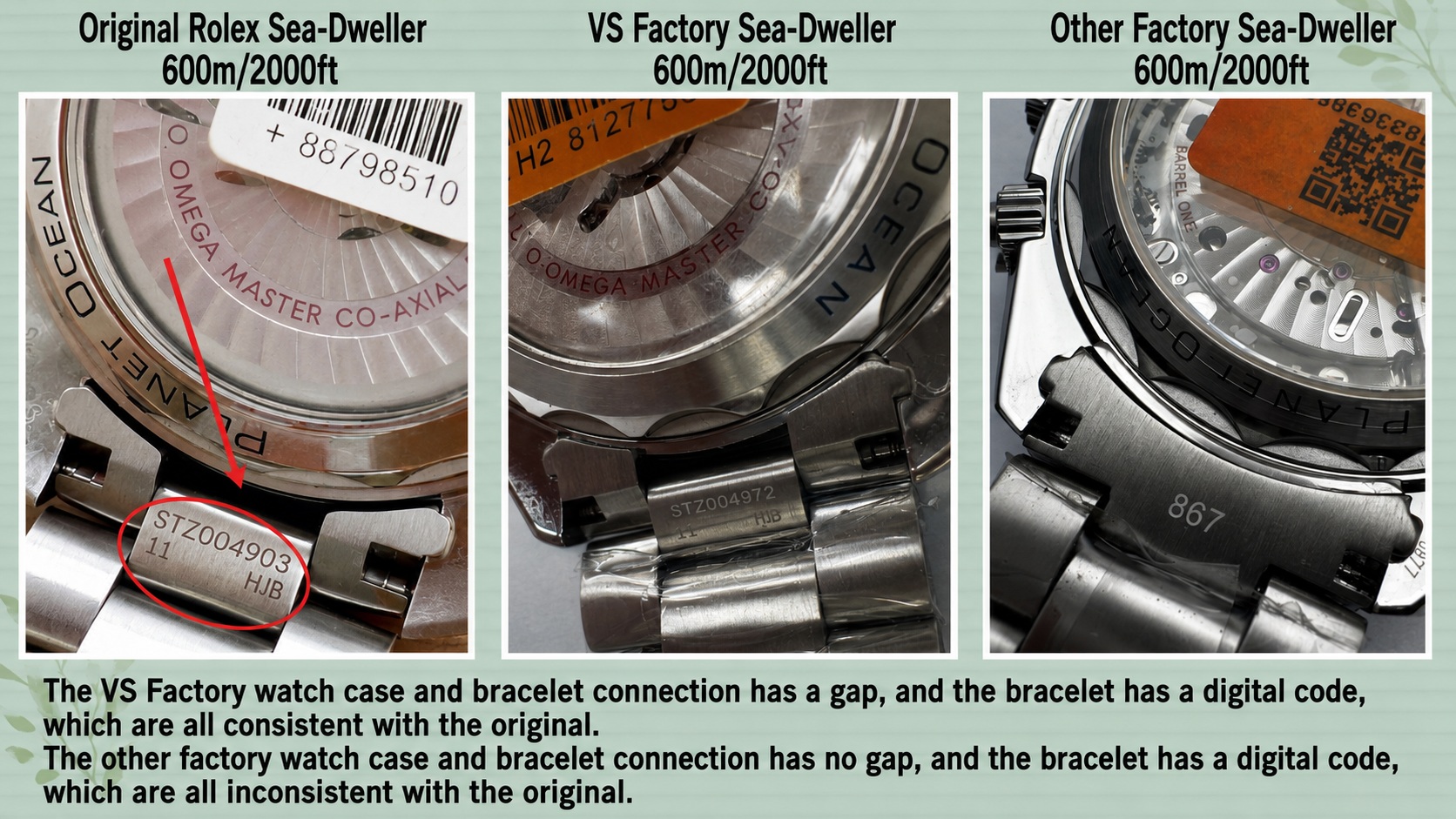
The VSF sample uses darker, deeper-looking perimeter text for “PLANET OCEAN 600m / 2000ft,” while the low-grade lettering appears lighter and more superficial. Through the exhibition back, the VSF side also presents a more coherent bridge and rotor layout.
A movement photo is still not a performance test. It can compare layout, decoration, jewel positions and visible cleanliness. It cannot establish calibre identity, beat-rate stability, power reserve, shock resistance, magnetic resistance or service life. The genuine Omega Calibre 9900 is METAS-certified; a replica movement is not.
5. Bracelet End-Links and Lug Fit
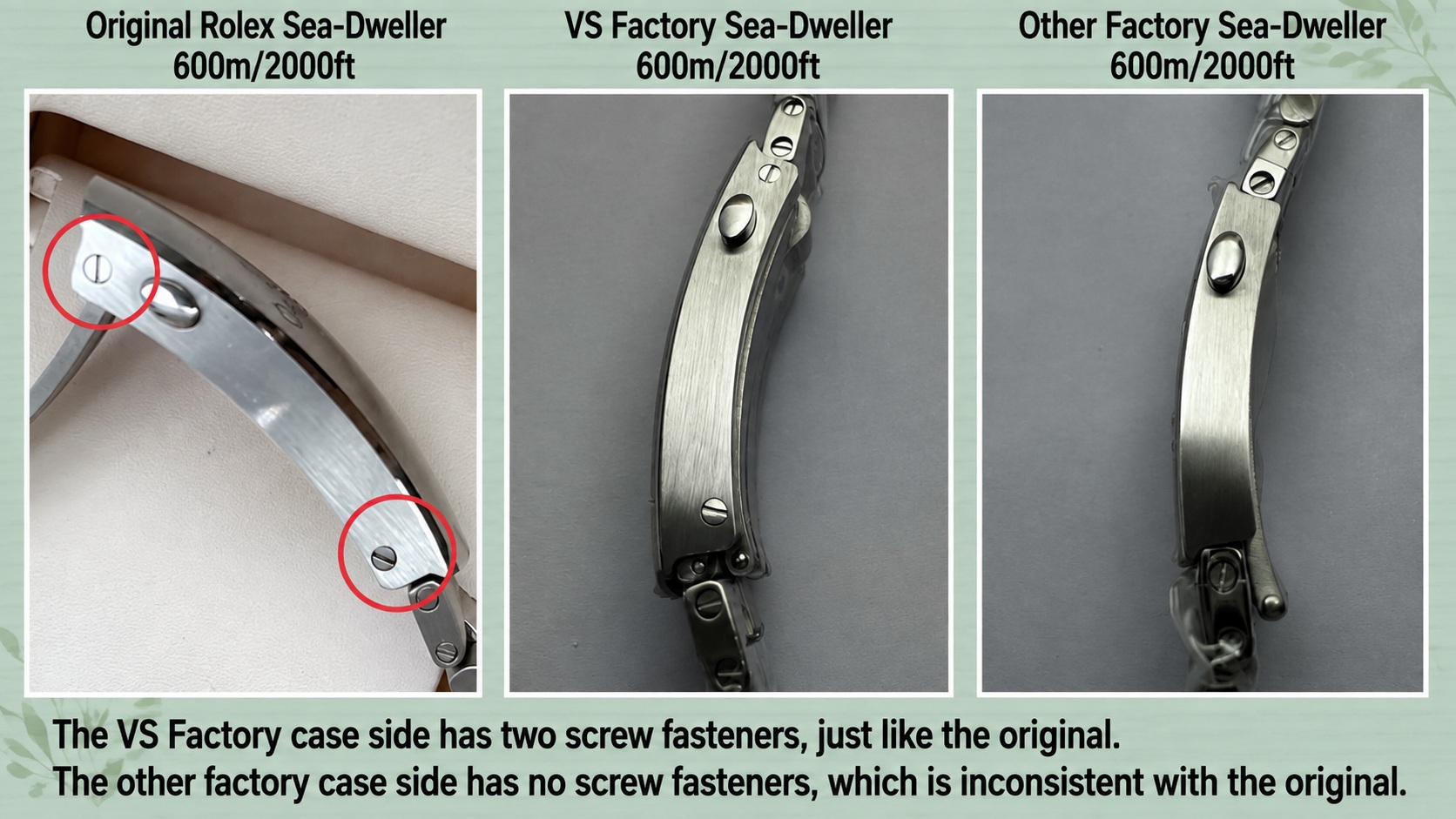
Bracelet fit should not be reduced to “gap” versus “no gap.” The relevant question is whether the end-link follows the intended case geometry, sits evenly between both lugs and articulates without binding. In the comparison image, the VSF side shows a controlled micro-recess and a clearer underside code. The low-grade side looks flatter and less defined.
- Inspect all four end-link corners from a square rear view.
- Compare vertical seating at 12 and 6 o’clock; one side should not stand obviously proud of the case.
- Ask for a short articulation video. A still image cannot reveal binding, loose spring bars or sharp bracelet edges.
- Do not reject a unit for a dark line created only by shadow or protective film. Confirm it from a second angle.
6. Clasp Adjustment, Screws and Proportions
Internal PUSH micro-adjustment assembly
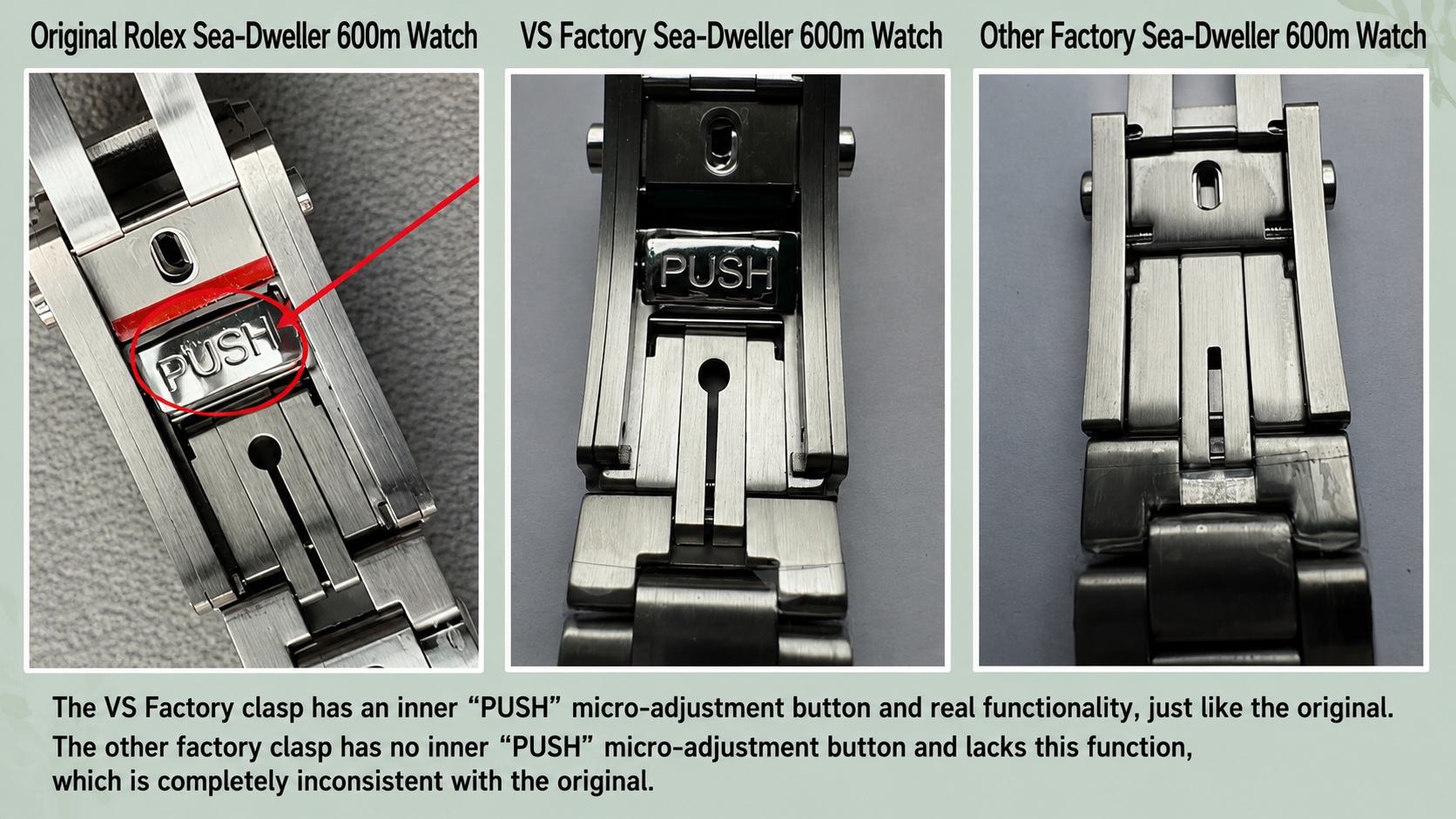
The clasp interior is a decisive functional area. The VSF sample contains the rails, spring hardware and PUSH control associated with a multi-position comfort adjustment. The budget sample uses a solid-looking dummy plate without the same visible mechanism.
The photograph confirms architecture, not operation. Ask for one continuous video that opens the clasp, presses the control, moves the slider through its positions and locks it again. The slider should not skip, jam or release without the control being pressed.
Side fasteners, separable links and clasp length
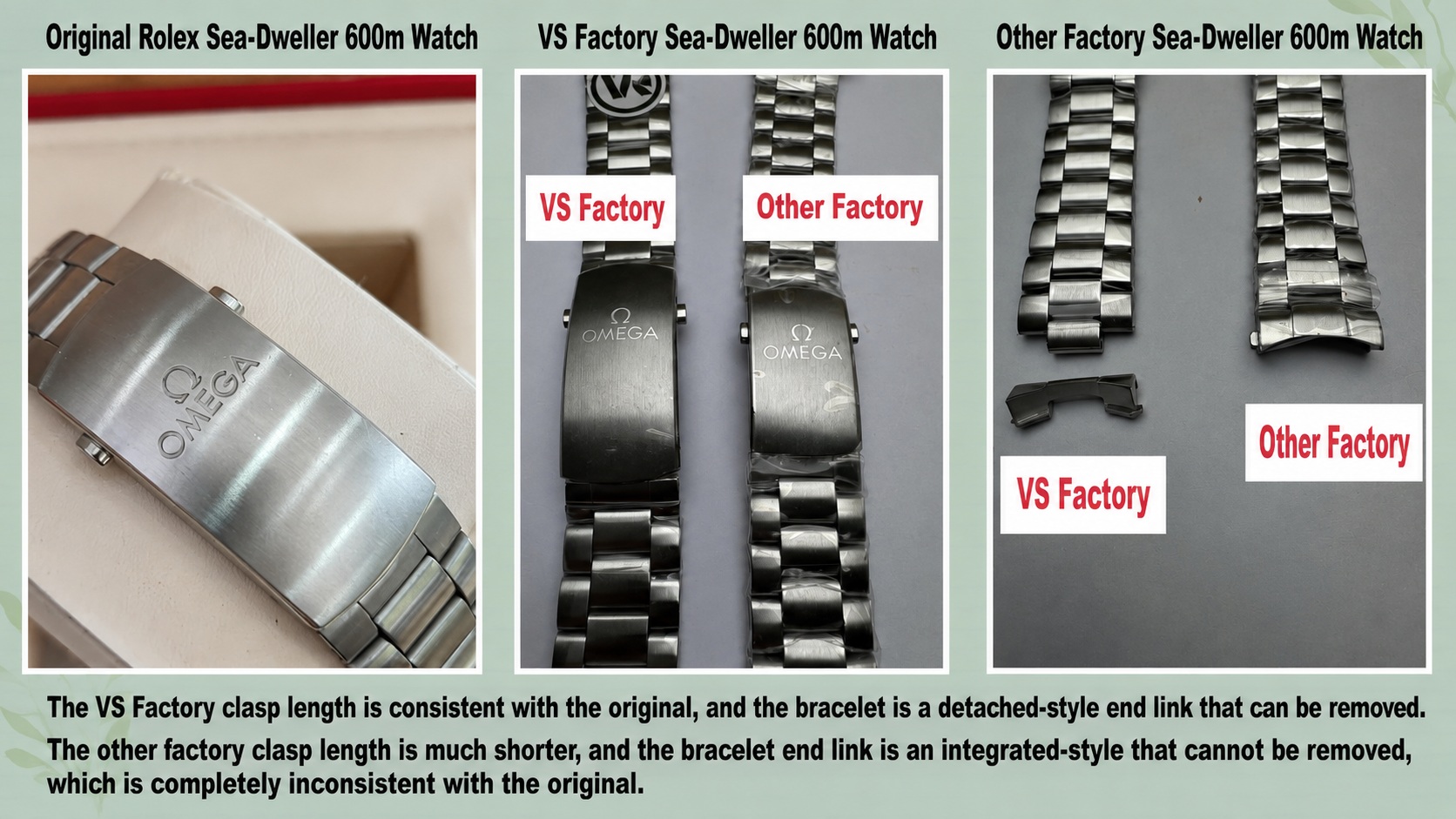
The VSF clasp in the sample follows the longer original-style profile and uses a separable first-link arrangement. The budget assembly shortens and simplifies that structure. Threaded side fasteners also make correct servicing and link work more plausible than smooth welded side walls, but the exact unit should be checked for damaged screw heads or seized threads.
7. VSF vs Low-Grade Omega Planet Ocean Comparison
| Component | Reference design target | VS Factory sample | Low-grade sample |
|---|---|---|---|
| Applied logo and 12 marker | Polished applied emblem and clean lacquered accent | Rounded reflective edges; smooth glossy orange insert | Flatter stamping; rougher matte orange texture |
| Chronograph registers | Recessed registers with defined rims and azurage | Visible step-down, chamfer and concentric texture | Flatter printed appearance with limited depth |
| Dial and crystal | Black ceramic dial; double-sided AR on genuine crystal | Deeper gloss and lower visible glare in the photo | Greyer matte surface and stronger light diffusion |
| Rear-lug markings | Crisp, consistently positioned case identification | Emblem, material lettering and serial group present | Simplified serial-only treatment |
| Caseback | Defined perimeter text and coherent exhibition-back layout | Darker, deeper-looking lettering and fuller decoration | Light laser text and simplified appearance |
| End-links | Controlled case transition and serviceable bracelet fit | Defined recess, code and separable architecture | Flatter transition and reduced underside detail |
| Clasp adjustment | Comfort setting and diver-extension functionality | Visible PUSH slider, rails and spring hardware | Fixed dummy-style plate |
| Evidence still required | Official specifications and certification | Exact-unit function, timing, pressure and movement checks | Same checks, with additional identity verification |
8. VS Factory Omega Planet Ocean 600M Chronograph QC Checklist
A strong macro comparison helps identify where to look. Approval should still depend on evidence from the exact watch being shipped. Use this checklist before accepting a VSF Planet Ocean Chronograph unit:
- Identity: request an order marker in the frame, current-batch confirmation and consistent serial/film details across all photos.
- Dial alignment: obtain a level, centered image. Check the applied emblem, 12 marker, date window, sub-dials and minute track independently.
- Chronograph registers: ask for a shallow-angle close-up that shows the recessed steps and surface texture.
- Crystal: compare straight and oblique views for distortion, scratches, coating marks and excessive glare.
- Case and engravings: inspect both lug undersides, case flanks, crown, pushers, helium-valve area and caseback text.
- Bracelet: review all four end-link corners and request articulation video for the first links.
- Clasp: record the PUSH adjustment moving through multiple positions, then locking under light tension.
- Chronograph function: show start, stop and reset in one continuous video. The central seconds hand and register hands should return cleanly to zero.
- Crown functions: demonstrate winding, time setting and date change. Confirm the exact movement label separately from seller shorthand.
- Timing and reserve: request timegrapher video with position, state of wind and test settings disclosed. Power reserve requires a timed test, not a movement photo.
- Water resistance: never inherit the genuine watch’s 600 m rating. Treat the replica as unverified until the exact unit passes an appropriate pressure test.
- Final cleanliness: check under the crystal, around the date aperture, on hands and markers, and inside the visible caseback for dust or debris.
What these photographs cannot prove
Static macro images cannot establish the steel grade, ceramic composition, coating stack, actual movement calibre, regulation, reserve, waterproofing or service condition. They also document one comparison set rather than every VS Factory production batch. Current-batch QC remains necessary even when the reference sample looks excellent.
The genuine 45.5 mm chronograph is also physically substantial at 52.30 mm lug-to-lug, 18.87 mm thick and approximately 262 g on steel. Independent hands-on coverage notes that it wears best when secured snugly and may feel top-heavy on smaller wrists. Ask for the replica’s measured dimensions and weight if fit is a deciding factor.
9. Final Verdict: Is the VSF Planet Ocean 600M Worth Choosing?
Against the low-grade batch shown here, the VS Factory Omega Planet Ocean 600M Chronograph is the stronger technical build. The advantage is visible across independent components rather than one marketing label: applied dial finishing, register depth, optical clarity, engraving execution, caseback presentation, end-link construction and a more complete clasp mechanism.
The correct conclusion is not that the VSF sample is indistinguishable from genuine. The genuine Omega remains different in certified movement performance, materials control, pressure testing, finishing tolerances, service support and provenance. The practical conclusion is that VSF preserves more of the Planet Ocean Chronograph’s intended engineering than the budget sample, while exact-unit QC still decides whether a particular watch is acceptable.
The exact 45.5 mm chronograph is not currently represented by a dedicated live product listing on this site. For related configurations, compare the 43.5 mm black-dial Planet Ocean 600M and the 43.5 mm black/orange Planet Ocean 600M, or browse the complete VS Factory Omega catalog. Confirm size, reference and movement before ordering because those linked models are not the 45.5 mm chronograph reviewed above.
Need proof from the current batch? Request unit-specific Planet Ocean photos, chronograph video and clasp-adjustment evidence on WhatsApp.
Related Omega Guides
Frequently Asked Questions
What is the main difference between VSF and a low-grade Planet Ocean 600M?
In this comparison set, the clearest differences are the polished applied logo, glossy 12 marker, recessed chronograph sub-dials, deeper dial surface, cleaner lug engravings, darker caseback lettering, defined end-links and the working-style PUSH clasp architecture. Inspect the exact unit because batch variation remains possible.
Is the VS Factory Omega Planet Ocean 600M the same as genuine?
No. The VSF sample follows the visual and structural target more closely than the budget batch, but it does not carry Omega provenance, METAS certification, genuine Calibre 9900 performance, official pressure testing or Omega service support.
Is a VSF Planet Ocean replica really water resistant to 600 metres?
Do not assume that. The 600 m rating belongs to the genuine Omega reference. Treat every replica unit as unverified until the exact watch passes an appropriate pressure test performed under disclosed conditions.
Which movement is inside the VSF Planet Ocean 600M Chronograph?
A caseback photo can compare visible architecture, but it does not authenticate the calibre or prove performance. Ask the seller to identify the current batch and movement, then request movement photos, a complete chronograph-function video and timegrapher evidence for the exact unit.
What should I check in VSF Planet Ocean QC photos?
Check exact-unit identity, dial and date alignment, recessed sub-dials, crystal clarity, case markings, caseback text, end-link seating, clasp adjustment, chronograph start-stop-reset, crown functions, timing evidence and cleanliness. Water resistance and reserve need separate tests.
How large is the genuine Omega Planet Ocean 600M Chronograph?
Omega lists Ref. 215.30.46.51.01.001 at 45.5 mm wide, 52.30 mm lug-to-lug, 18.87 mm thick, with a 22 mm lug width and an approximate steel-bracelet weight of 262 g. Use these as a genuine baseline and request measured replica dimensions separately.
Where can I compare current VS Factory Omega models?
Browse the Omega collection and verify the exact reference, case size, dial, bezel, bracelet and movement listed for each model. The related 43.5 mm Planet Ocean listings are not the 45.5 mm chronograph analyzed in this article.
Reference Notes
- Omega Ref. 215.30.46.51.01.001 – official genuine-watch description, dimensions, material, movement and certification baseline.
- Hodinkee launch coverage – independent coverage of the 45.5 mm chronograph, Calibre 9900, 60-hour reserve and 600 m genuine-watch rating.